Is Bitcoin Really Valuable? Breaking Down Scarcity, Security and Adoption
Share
Key Takeaways
Bitcoin’s scarcity is hard-coded, with a fixed 21 million supply and predictable issuance schedule, making it more resistant to inflation than fiat currencies.
Decentralization and security ensure Bitcoin operates without central authority, while Proof-of-Work mining makes it extremely difficult to attack.
Network effects, explained by Metcalfe’s Law, mean Bitcoin becomes exponentially more valuable as adoption grows among individuals, institutions, and even governments.
Macroeconomic conditions, like persistent inflation, debt crises, and geopolitical instability, continue to position Bitcoin as a hedge and safe-haven asset in global finance.
In just over 15 years, Bitcoin has evolved from a niche digital experiment into one of the largest and most recognized assets on Earth. By mid-2025, it is not only the dominant cryptocurrency by market capitalization but also ranks alongside gold, top equities, and major commodities in total market value.
This dramatic rise leads to the fundamental question: Why is Bitcoin valuable?
The answer lies in a powerful combination of engineered scarcity, decentralized security, network effects, and macroeconomic appeal, supported by valuation models that show its long-term potential.
How Bitcoin’s Scarcity Creates Digital Gold
Scarcity has been a driver of value for centuries, from precious metals to rare art. Bitcoin brings that principle into the digital era.
Top Crypto Tax Software
Sponsored
Disclosure
We sometimes use affiliate links in our content, when clicking on those we might receive a commission at no extra cost to you. By using this website you agree to our terms and conditions and privacy policy.
Fixed supply: As a report by Amina Bank notes, Bitcoin’s fixed 21 million supply creates a form of digital scarcity analogous to gold’s natural rarity. In other words, just as gold’s limited availability underpins its value, Bitcoin’s predetermined scarcity is a cornerstone of its worth. Changing this would require near-unanimous agreement among thousands of independent network participants, a near impossibility
Halving events: Roughly every four years, the new supply of Bitcoin is cut in half. The 2024 halving reduced the reward from 6.25 BTC to 3.125 BTC per block. These halvings steadily reduce Bitcoin’s annual inflation rate and increase its stock-to-flow ratio (S2F), a measure of scarcity comparing existing stock to new supply.
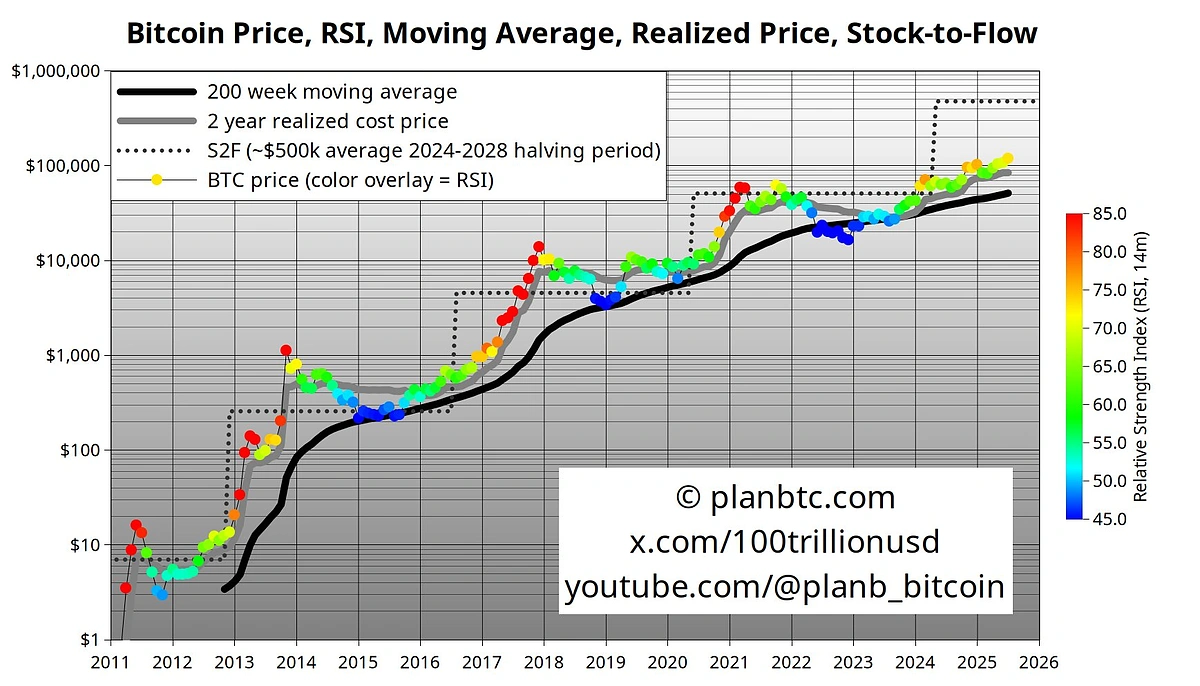
Stock-to-flow (S2F) ratio: . By mid-2025, Bitcoin’s S2F ratio has risen to levels higher than gold’s (gold’s S2F is 62), reflecting how scarce Bitcoin has become relative to its supply growth. According to the stock-to-flow valuation model, assets with higher S2F ratios (like gold or Bitcoin post-halving) are theoretically more valuable due to their scarcity. This model, popularized by analyst PlanB, even predicted Bitcoin’s price surges in past bull markets, though it has faced criticism and divergence since late 2021.
Bitcoin Price, RSI, Moving Average, Realized Price, Stock-to-Flow | Source: @100trillionUSD on X
In simple terms, Bitcoin is designed to become more scarce over time. About 94% of all Bitcoins have already been mined as of 2025, and the creation of the last bitcoins will stretch out over the next century. Eventually (around the year 2140), no new supply will enter circulation after all 21 million are mined.
This scarcity means that if demand for Bitcoin keeps rising, the supply-demand dynamics naturally put upward pressure on its price. It’s the opposite of most fiat currencies, which lose value each year as new units are printed by central banks. Bitcoin’s rarity is thus a protective feature, Amina’s research highlights that a hard cap like Bitcoin’s helps shield holders from the value erosion that comes when governments print too much money.
“Digital Gold” Narrative
Due to this strictly limited supply, Bitcoin is frequently referred to as “digital gold.” Like gold, it cannot be debased by increasing its supply, and it serves as a store of value that people can hold as protection against inflation.
In fact, Bitcoin’s monetary supply schedule is even more predictable and inflexible than gold’s. Gold miners typically increase the above-ground gold supply by 1–2% per year, whereas Bitcoin’s supply growth rate gets cut in half every four years and will trend toward zero.
2013, 2017, 2021, and now 2025: All post-halving years. #Bitcoin typically bottoms in early August and rallies afterwards 🚀 pic.twitter.com/MPaOtmeFzR
Advocates argue that this makes Bitcoin even scarcer than gold in the long run, bolstering its value as an investment asset. By mid-2025, Bitcoin’s price movements were increasingly correlated with gold, reinforcing the idea that global investors see it as a digital safe-haven asset.
Bitcoin’s Decentralization & Security: Trust in Code, Not Central Banks
Bitcoin’s second pillar of value is its governance model: decentralized, secure, and transparent.
Decentralized network: Thousands of independent nodes and miners enforce Bitcoin’s rules globally. No single government, bank, or corporation can alter the supply or block valid transactions.
Proof-of-work security: Miners secure the network by solving complex mathematical puzzles, consuming real-world energy and computing power. By mid-2025, the Bitcoin network’s total hash rate exceeded 1 exahash per second (that’s 1 quintillion hash computations per second on average), an 84% increase from a year earlier. This metric is not just a number, it represents the sheer difficulty of attacking the network. A malicious actor would need billions of dollars’ worth of mining hardware and energy to even attempt to outcompete honest miners and rewrite transaction history. In fact, security experts consider Bitcoin’s network effectively immune to 51% attacks, because the cost to acquire the majority of hashing power is prohibitively high. Every additional mining rig that joins the network makes it even harder to compromise, creating a fortress of computational security.
Censorship resistance: In countries like Argentina, Nigeria, and Lebanon, Bitcoin has served as a financial lifeline, enabling citizens to protect savings and transact despite inflation, capital controls, or banking instability. Such examples highlight how Bitcoin’s decentralization gives it value as a self-sovereign form of money, a lifeline when traditional systems falter.
With more than 14 years of uninterrupted operation and no successful protocol-level breaches, Bitcoin has proven itself as a trustless, tamper-resistant monetary system.
Network Effects: Bitcoin’s Self-Reinforcing Growth (Metcalfe’s Law in Action)
Bitcoin’s value is amplified by the network effect, the principle that a network becomes more valuable as more people use it.
Metcalfe’s Law quantifies this: the value of a network is proportional to the square of its number of users. In Bitcoin’s case, each new holder, institution, or government that joins the network increases its utility and appeal for everyone else.
Key milestones include:
Mass Adoption
From a handful of cypherpunks in 2009, Bitcoin now has hundreds of millions of users. As of 2025, roughly 4% of the global population owns Bitcoin, and about 6–7% owns cryptocurrency in general, according to industry surveys.
This includes everyday retail investors across the globe using Bitcoin as an investment, a savings vehicle, or even for remittances and payments. Such broad adoption adds resilience and value, Bitcoin is not reliant on any single country or demographic; it has truly become a global network of users.
High demand in regions like North America, Europe, and East Asia is now complemented by growing usage in emerging markets (often driven by local currency issues or fintech apps integrating Bitcoin). The more widely Bitcoin ownership spreads, the more liquid and accepted it becomes, reinforcing its worth.
Institutional Involvement
In 2020, public companies like MicroStrategy (now renamed Strategy) and Tesla made headlines by buying Bitcoin as a reserve asset. Fast forward to 2025, and this trend has only grown. There are now over 100 public and private companies that hold Bitcoin in their treasuries, collectively owning more than 1 million BTC (over $100 billion in value as of May 2025). These include crypto-native firms (like exchange Coinbase or mining companies) and mainstream businesses. For example, Tesla holds about 11,509 BTC on its balance sheet, worth over $1 billion. Such moves signal that companies view Bitcoin as a legitimate long-term store of value or strategic asset, much like cash or gold.
The launch of U.S. spot Bitcoin ETFs (exchange-traded funds) in 2024 and early 2025 opened the floodgates for traditional investors to gain Bitcoin exposure easily. By mid-2025, U.S. Bitcoin ETFs had amassed roughly $14–20 billion in net inflows, allowing pensions, mutual funds, and individuals to invest in BTC through familiar stock-market vehicles. For instance, BlackRock’s iShares Bitcoin Trust raised over $1.3 billion within days of launch. These inflows reflect new demand pouring into Bitcoin, driving up its price and market capitalization. Moreover, ETFs provide regulatory-approved avenues to invest, which increases comfort for many institutions.
Major banks and asset managers now increasingly offer crypto services. By 2025 many large banks (from Morgan Stanley to Deutsche Bank) have either integrated custody for Bitcoin or are facilitating client investments in crypto. Asset management giants like BlackRock and Fidelity not only launched ETFs, but some have started including Bitcoin in model portfolios or research for diversification. This institutional acceptance is crucial: it means Bitcoin is being treated as a serious asset class by those who manage trillions in traditional capital.
Even governments have dipped in: In March 2025, the United States (under President Donald Trump) signed an executive order to establish a Strategic Bitcoin Reserve, reportedly acquiring 200,000 BTC for national strategic holdings.
While unprecedented, this move sent a clear message of government support for Bitcoin and further legitimized it as a reserve asset. (El Salvador was the first country to adopt Bitcoin as legal tender in 2021, and a few others have considered or enacted similar measures on a smaller scale.) Each step of official adoption reduces perceived risk and answers the question “is Bitcoin here to stay?” with a resounding yes, which encourages more investors to buy in.
The value of adoption cannot be overstated. Each new participant, whether it’s a small retail buyer or a multi-billion-dollar fund, adds to the demand and network effect of Bitcoin. It also reduces volatility over the long term by distributing coins among more holders.
Furthermore, as more infrastructure is built (exchanges, payment processors, financial products, etc.), Bitcoin becomes ideal to use and more ingrained in the economy.
Think of it this way: ten years ago, very few merchants accepted Bitcoin and few regulators had clarity on it; today, you can buy a cup of coffee with Bitcoin via a Lightning Network payment in some cities, and you can trade Bitcoin on the New York Stock Exchange via ETF.
Such progress feeds a virtuous cycle making Bitcoin more accessible, useful, and trusted, thereby increasing its market value.
It’s also worth noting that Bitcoin’s first-mover advantage and brand play a role here. There are thousands of cryptocurrencies, but none has the recognition and widespread support of Bitcoin. Alternative coins (even large ones like Ethereum) compete in various niches, but for the singular purpose of a decentralized store of value, Bitcoin’s network effect gives it an enormous lead.
As one observer quipped, in crypto “narratives keep changing” with new projects, but Bitcoin’s network effect is a primary reason it continues to dominate in market share. This entrenched position further solidifies why value accrues to Bitcoin more so than to its many imitators.
Macroeconomic Drivers: Bitcoin as a Hedge and Safe Haven Explained
Bitcoin’s adoption has accelerated not only due to its technological design but also because of economic realities that make it an attractive alternative to traditional assets.
Inflation Hedge
Over the past decade, central banks, from the U.S. Federal Reserve to the European Central Bank, have greatly expanded their money supplies to stimulate economies and manage crises. While this can support growth in the short term, it steadily erodes the purchasing power of fiat currencies.
Bitcoin’s fixed cap of 21 million coins offers a stark contrast.
No matter how much money is printed or how deep deficits run, Bitcoin’s issuance schedule is locked in. This makes it appealing to savers and investors seeking protection from currency debasement. In inflation-hit countries like Argentina and Turkey, local Bitcoin adoption has often surged as citizens seek more stable stores of value.
WisdomTree’s research in 2025 pointed out that persistent inflationary pressures and loose monetary policy are supportive drivers for Bitcoin’s price.
Safe-Haven Asset
Like gold, Bitcoin tends to see demand spikes during financial instability. Its independence from any single nation’s economy shields it from the policy failures, debt crises, or banking collapses of individual countries.
During the banking turmoil of early 2023 and sovereign debt concerns in 2024, Bitcoin’s price rose alongside gold as investors sought diversification away from traditional assets.
An analysis by Amina Bank showed Bitcoin’s price closely tracking the expansion of global M2 money supply over the past years. When Zimbabwe experienced hyperinflation in 2008 or Venezuela in the late 2010s, local interest in Bitcoin spiked as people sought refuge in something that governments couldn’t inflate.
Even in more developed economies, if inflation erodes the value of savings (e.g., a 5-10% annual loss of purchasing power), Bitcoin’s appreciation potential and scarcity offer a compelling alternative.
By mid-2025, investors widely acknowledged Bitcoin as an inflation-resistant asset alongside gold. It’s not a perfect hedge month-to-month (Bitcoin’s short-term volatility can outweigh inflation rates), but over longer periods, the trend of Bitcoin’s growth has outpaced inflation, rewarding those who held it during loose monetary regimes.
Low Interest Rates and “Store-of-Value” Demand
Over the past decade, ultra-low or even negative interest rates made holding cash unattractive (since it yields nothing and loses value to inflation).
This environment fueled the search for better stores of value, benefiting assets like stocks, real estate, and yes, Bitcoin.
While interest rates have risen by 2025 to combat inflation, the broader idea remains: Bitcoin has positioned itself as a kind of reserve asset in the digital realm. Major hedge fund managers and even some central bankers have discussed Bitcoin’s potential role in a diversified reserve mix, especially if fiat currency depreciation continues.
Comparing Bitcoin to Gold and Fiat Currencies
Bitcoin’s strengths and limitations become clearer when compared to other major asset classes.
Features
Bitcoin (BTC)
Gold
Fiat Currencies
Supply Limit
Fixed at 21M
Limited (1–2% growth)
No limit
Form
Digital
Physical
Digital/Physical
Portability
Send globally in minutes
Heavy, costly to move
Easy domestically, slower cross-border
Divisibility
1 BTC = 100M sats
Difficult physically
Highly divisible
Control
Decentralized
No single issuer
Centralized
Security model
Proof-of-work
Physical rarity
Government backing
Main Use Case
Store of value, hedge, transfers
Store of value, jewelry, industry
Transactions, policy tools
Volatility
High
Low
Low–moderate
History
Since 2009
Thousands of years
20th century
Yield
None (protocol level)
None
Interest possible
Bitcoin vs. gold: Both are scarce stores of value, but Bitcoin is easier to move, divide, and verify. Gold, however, has unmatched historical trust and stability. Many investors hold both for balance.
Bitcoin vs. fiat: Fiat dominates daily payments due to stability and legal tender status, but is inflation-prone. Bitcoin offers an inflation-proof alternative, particularly in unstable economies.
Valuation Frameworks: How Investors Gauge Bitcoin’s Worth
Because Bitcoin is unlike any asset before it (a digital, decentralized commodity/currency), investors have proposed various frameworks to evaluate what its fair value or future value could be.
Here are a few popular valuation models and narratives that help explain Bitcoin’s value:
Because Bitcoin is part commodity, part currency, and part technology network, multiple valuation models are used:
Stock-to-flow model (S2F): This approach values Bitcoin like a scarce commodity, comparing the existing circulating supply (“stock”) to the annual new issuance (“flow”). As halvings reduce Bitcoin’s flow, its stock-to-flow ratio rises, making it increasingly scarce. Advocates argue this scarcity drives price appreciation, similar to gold. While the S2F model seemed accurate during earlier bull markets, it later diverged from actual prices, highlighting its limits. Still, it emphasizes Bitcoin’s unique programmed scarcity and helps explain why many view it as “harder” than gold, given its declining inflation rate.
Metcalfe’s Law and network effects: Another view values Bitcoin as a network, suggesting its worth grows with the square of its users. Each new participant strengthens liquidity, trust, and utility, reinforcing adoption. Analysts often track metrics such as active addresses to gauge this effect. Bitcoin’s dominance shows how network effects make it the default store-of-value in crypto, much like social networks become stronger as more people join.
The “Digital Gold” thesis: Perhaps the most intuitive model compares Bitcoin directly to gold’s multi-trillion-dollar market. Supporters argue Bitcoin is more portable, divisible, and verifiable than gold, while maintaining scarcity. If Bitcoin captures even part of gold’s role as a store of value, its price could rise significantly. Critics counter that Bitcoin lacks physical utility, but supporters note gold’s value is also largely social consensus.
Other models: Additional perspectives include mining cost models, adoption curves, and relative comparisons to money supply or global assets. Ultimately, Bitcoin’s value is set by open markets, but scarcity, network effects, and the digital gold narrative remain the key pillars investors use to frame its potential.
Future Outlook
Bitcoin’s long-term trajectory will depend on adoption rates, regulatory clarity, macroeconomic trends, and technological improvements like the Lightning Network.
Bullish scenarios see Bitcoin as a global reserve asset; more conservative forecasts place it as a mature, niche store of value.
Bitcoin Volatility: Why Prices Swing So Wildly
It is important to recognize that despite its growing role in portfolios, Bitcoin remains highly volatile. Unlike gold, which has centuries of history and relatively stable price behavior, Bitcoin can swing dramatically within short periods.
In 2025, for instance, it surged past $109,000 in March before falling below $80,000 only weeks later. Moves of 20% or more are not uncommon, making it an unreliable short-term hedge against inflation compared with traditional tools such as gold or inflation-protected bonds.
For now, Bitcoin functions more as a speculative store of value, volatile in the short run but trending upward over longer horizons. Many investors accept this instability as the cost of participating in an asset with asymmetric upside. Still, the swings limit its utility as a day-to-day stable value holder or transactional currency.
Bitcoin’s volatility keeps falling.
Since 2022, Bitcoin has already been less volatile than mega-cap stocks like Nvidia.
And since 2024, despite hitting new highs and going through a significant correction, volatility has kept trending lower. It’s now near a five-year low.… pic.twitter.com/NYwz2Ov1vv
There is, however, a widely held expectation that volatility will moderate as adoption grows, liquidity deepens, and Bitcoin becomes more entrenched in financial markets. Gold itself experienced similar turbulence in the 1970s after the U.S. abandoned the gold standard, but eventually stabilized once it was widely held as a reserve asset. If Bitcoin follows a comparable path, its price behavior may gradually resemble that of a mature store of value.
For now, Bitcoin straddles the line between hedge and speculation. It can serve as protection against inflation, currency debasement, or financial repression, but not without exposing investors to substantial short-term price risk.
Prudent allocators therefore treat Bitcoin as a high-beta hedge, positioning it modestly within portfolios, balancing its long-term potential against the reality of ongoing volatility.
Quantum Computing and Bitcoin: A Future Risk Factor
When people ask, “What could challenge Bitcoin in the long run?” one of the most common answers is quantum computing. Quantum machines are designed to solve certain problems much faster than today’s classical computers, including some of the mathematical puzzles that protect digital assets.
But here’s the important part: Bitcoin is not defenseless.
Why Quantum Computing Matters
Bitcoin’s security today relies on two core cryptographic systems:
SHA-256 hashing (used in mining and block creation)
ECDSA signatures (used to prove ownership of funds when sending BTC).
Quantum computers may eventually become powerful enough to solve these equations more efficiently. That possibility has sparked debate in both academic and crypto circles.
The Current Reality
Despite rapid progress, quantum computers are still far from being able to break Bitcoin. Even the most advanced prototypes built by Google, IBM, and others operate at a scale that is nowhere near the requirements to compromise Bitcoin’s cryptography.
Estimates from researchers suggest it would take thousands, if not millions, of stable quantum bits (“qubits”) to pose a realistic challenge, well beyond current capabilities.
How Bitcoin Can Adapt
The real strength of Bitcoin is not just its scarcity or security today, but its ability to adapt over time. Unlike fiat currencies, where monetary policy is shaped by political cycles, or gold, which cannot be altered at all, Bitcoin evolves through open-source development and decentralized governance.
A History of Successful Upgrades
Bitcoin has already proven its capacity to upgrade without compromising its core principles:
SegWit (2017): Optimized block capacity and paved the way for scaling solutions like the Lightning Network.
Taproot (2021): Improved privacy, smart contract flexibility, and transaction efficiency.
Ongoing BIPs: Smaller technical improvements are regularly proposed, debated, and implemented by the community.
Each of these changes required broad consensus among miners, developers, and node operators, showing that Bitcoin can modernize while preserving decentralization.
Preparing for Quantum Resilience
Developers are now researching post-quantum cryptography, new signature schemes resistant to quantum attacks. If breakthroughs in quantum computing demand it, Bitcoin could transition to quantum-safe algorithms via a Bitcoin Improvement Proposal (BIP).
In mid-2025, Bitcoin developers stirred debate with a proposal from Jameson Lopp’s team to restrict spending from legacy pay-to-pubkey (P2PK) addresses, including those tied to Satoshi Nakamoto. The idea was to preemptively defend against potential quantum threats by freezing older, more vulnerable coins and encouraging migration to quantum-safe formats.
Supporters see it as a proactive step to protect the network, but critics warn it could permanently lock away historic holdings and raise fairness concerns.
The controversy highlights Bitcoin’s governance dilemma: balancing forward-looking security with respect for immutability and the principles of decentralized, owner-controlled money.
Governance by Consensus, Not Control
Bitcoin’s governance model is unique: no central authority can impose change. Instead, improvements emerge from:
BIPs openly debated in the community.
Consensus-driven adoption, where upgrades only succeed if the majority of participants agree.
Market forces, since users ultimately decide whether to run updated software.
This system makes upgrades slower than in centralized projects, but also more robust. It ensures that Bitcoin adapts cautiously, balancing innovation with immutability.
Why This Adds to Bitcoin’s Value
Quantum computing is not an immediate crisis for Bitcoin, but it does represent a long-term risk that investors and developers take seriously. If advances come faster than expected, the cryptography protecting Bitcoin’s signatures could be weakened, leaving wallets vulnerable. Unlike inflation or regulation, this is a technical risk, one that would require coordinated upgrades to mitigate.
What makes this both a strength and a weakness is Bitcoin’s governance.
On one hand, its open-source community has the tools to adopt quantum-resistant cryptography, and researchers are already exploring solutions.
On the other hand, reaching consensus for major changes can be slow and contentious. If the quantum timeline ever accelerates, Bitcoin may need to act quickly to protect trillions in value, something that hasn’t been stress-tested at that scale.
So rather than being a simple value-add, the quantum question is a double-edged sword. It shows that Bitcoin can adapt in theory, but also that its future depends on coordination, vigilance, and timely upgrades.
In plain terms: quantum computing doesn’t make Bitcoin worthless, but it keeps the pressure on the network to stay ahead of emerging technology.
Conclusion
Bitcoin’s value is built on more than hype. Its scarcity makes it resistant to inflation, its decentralization builds trust without intermediaries, its network effects accelerate adoption, and its macro appeal positions it as a modern safe haven.
While volatility remains, Bitcoin has already shown resilience across multiple market cycles. Whether it grows into a multi-trillion-dollar reserve asset or stabilizes as a digital counterpart to gold, it has firmly established itself as a key player in global finance.
What gives Bitcoin its value if it’s just digital?
Bitcoin’s value comes from scarcity and demand. Only 21 million will ever exist, making it digitally scarce like gold. People value it because it’s decentralized, secure, portable, and divisible. As more individuals, companies, and institutions adopt it, trust reinforces its worth. Similar to fiat money, value comes from collective belief, except with Bitcoin, trust is placed in transparent code and network consensus, not a central authority.
Can governments shut down Bitcoin?
No single government can shut down Bitcoin because it is decentralized and runs on thousands of independent nodes worldwide. However, they can regulate or restrict its use within their borders.
Is Bitcoin too volatile to be a good store of value or currency?
Bitcoin is highly volatile in the short term, with swings far larger than major currencies or gold. That makes it challenging as a day-to-day currency. However, over the long term, it has generally trended upward, outpacing inflation. Adoption and maturity have gradually reduced volatility, and in unstable economies, Bitcoin can still serve as both money and a store of value. For now, it’s best seen as a high-risk, high-reward asset.
Who or what actually determines Bitcoin’s price?
Bitcoin’s price is set by supply and demand on global crypto exchanges, trading 24/7. When buying pressure outweighs selling, the price rises; the reverse drives it down, much like stocks or gold. Influences include macroeconomic trends (inflation, rates), industry news (ETFs, regulation), network events (halvings), and overall sentiment. While big players or headlines can spark short-term swings, no single entity controls Bitcoin’s price. Over time, adoption growth and decreasing supply have been key drivers.
Disclaimer:
The information provided in this article is for informational purposes only. It is not intended to be, nor should it be construed as, financial advice. We do not make any warranties regarding the completeness, reliability, or accuracy of this information. All investments involve risk, and past performance does not guarantee future results. We recommend consulting a financial advisor before making any investment decisions.
Onkar Singh has three years of experience as a digital finance content creator. Throughout his career, he has collaborated with various DeFi projects and crypto media outlets. In his leisure time, he enjoys fitness activities at the gym and watching movies across different genres. Balancing his professional and personal interests, Onkar continues to contribute to the digital finance landscape while pursuing his hobbies.


 Easy
Easy